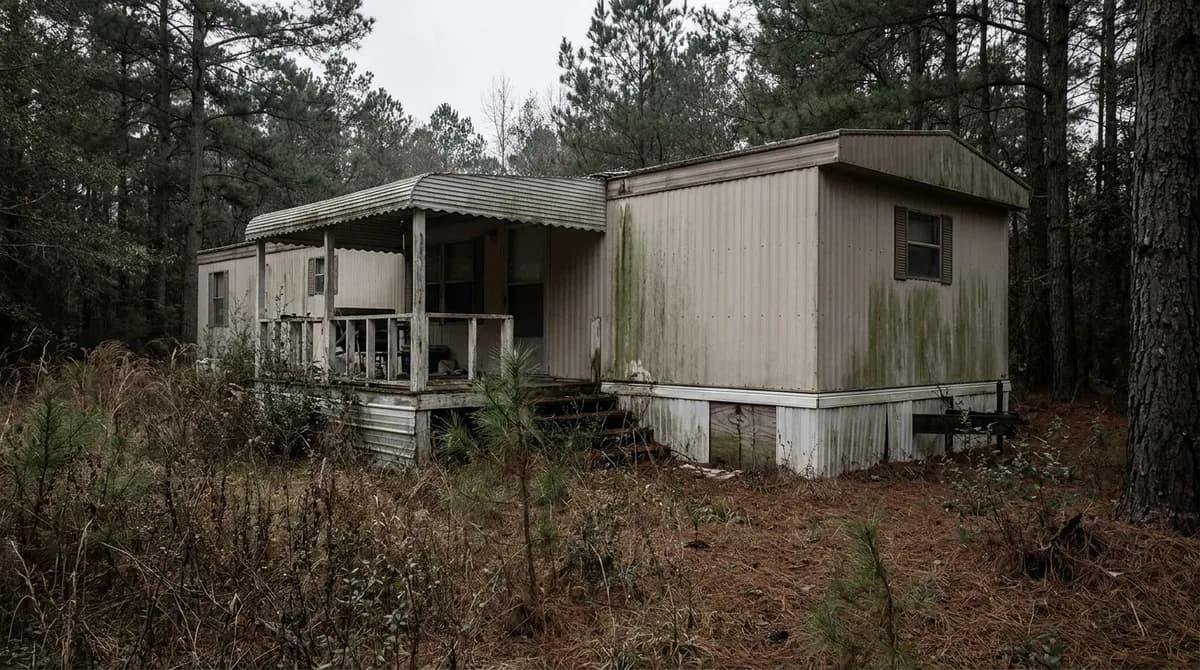
The call usually starts the same way. A parent died, there is a mobile home on a few acres out in Burke or McDuffie County, nobody wants to drive out and mow it, and the family wants to know what it is worth.
The answer is almost never a single number, because an inherited mobile home on land is usually two separate assets that pass by two separate legal routes, and one is easy to overlook.
First question: is the home part of the land, or is it a vehicle?
If the home was never converted to real property, Georgia still treats it as personal property under the Motor Vehicle Certificate of Title Act. It has a title, like a truck.
That means the deed to the land does not carry the home with it. You can inherit the dirt cleanly and still have no legal authority to sell the structure on it. This is the most common title defect on inherited mobile home properties, and it surfaces at the closing table when it is most expensive.
Check the county tax bill first. If the home shows up as a separate mobile home line, it is almost certainly still titled. If it is folded into the land assessment, somebody probably filed a Certificate of Permanent Location. We cover that conversion and its 2025 rule change separately.
Second question: which probate path fits
Georgia has more than one road here, and the cheap ones are genuinely cheap.
Year's Support. Under O.C.G.A. 53-3-1, a surviving spouse and minor children are entitled to year's support, and it is "to be preferred before all other debts or demands." Title to the property set apart vests directly, and where it is set apart for a surviving spouse alone, the spouse "shall thereafter own the same in fee, without restriction." Under 53-3-5(c) the petition must be filed within 24 months of the date of death. In rural Georgia this is the classic low-cost way a modest homeplace moves to a widow or widower, and its priority over most creditors is why.
No Administration Necessary. If the decedent died without a will, owed no debts (or every creditor consents), and all heirs agree in writing on the division, an heir can petition for an order that no administration is necessary. O.C.G.A. 53-2-41(d) says that order "shall confirm the vesting of title to the decedent's property in the heirs," and subsection (e) is what your closing attorney cares about: property later sold "to a purchaser or lender who acts in good faith reliance upon the order shall be discharged from all claims and rights of the creditors of the deceased owner," other than encumbrances already properly recorded. Note the veto in subsection (b): if a creditor objects and does not withdraw, the court will not grant it.
Actual administration. If there is a will, or debts, or heirs who disagree, you are in a real probate. A will probated in solemn form becomes conclusive against all persons six months after the order, while common form leaves a four year window under 53-5-19. Title insurers prefer solemn form for a reason. And absent a power of sale in the will, a personal representative generally has to petition for leave to sell estate real property under 53-8-13. The Council of Probate Court Judges publishes the standard forms, free to download.
Third question: how does a still-titled home actually change hands
If the home is still personal property, transferring it runs through the county tag office, not the deed room. The Georgia Department of Revenue's inherited vehicle guidance sets out what it takes: a completed MV-1 title application, the original title in the deceased's name with liens released, the $18 title fee, and one proof of inheritance: certified Letters Testamentary, a certified Year's Support order, or Form T-20, Affidavit of Inheritance with a certified death certificate.
The detail that catches people: on the T-20 route, the inheritor has to title the home in their own name before selling or transferring it. You cannot sign the old title over to a buyer and skip the middle step.
The part that protects families: Georgia's heirs property rule
Three siblings inherit forty acres. Two want to keep it. One wants out and threatens to force a sale. That threat used to be brutal, because a partition sale often meant an auction at a fraction of value.
Georgia adopted the Uniform Partition of Heirs Property Act, at O.C.G.A. 44-6-180 through 44-6-189.1, and under 44-6-181 it applies to partition actions filed on or after January 1, 2013. If the court determines the property is heirs property, "the property shall be partitioned pursuant to this subpart unless all of the cotenants otherwise agree in a record." In practice:
- The court orders an appraisal by "a disinterested real estate appraiser licensed in this state" under 44-6-184, unless the cotenants agree on value.
- Under 44-6-185, any cotenant who did not ask for a sale gets the right to buy out the ones who did, at appraised value times their fractional share, with a 45 day election window.
- If that does not resolve it, 44-6-186 says "the court shall order partition in kind unless the court... finds that partition in kind will result in manifest prejudice to the cotenants as a group," weighing duration of ownership, sentimental attachment, lawful use and contributions to taxes and upkeep, with no single factor dispositive.
So the sibling who wants out can get out, and the ones who want to keep the land usually can. That is a better position than families think, and worth knowing before anybody accepts a low number out of fear.
Taxes: the two questions everyone asks
Does Georgia tax the inheritance? No. The Georgia Department of Revenue states that "on and after July 1, 2014, there shall be no estate taxes levied by the state and no estate tax returns shall be required by the state," and that "Georgia has no inheritance tax."
Will we owe tax on the sale? Generally your basis resets. Under 26 U.S.C. 1014 the basis of inherited property is generally "the fair market value of the property at the date of the decedent's death," and IRS Publication 551 says the same. Gain is measured from that value, not from what your parents paid in 1987. That often means far less taxable gain than families fear, but alternate valuation and special-use elections exist, and this is a question for a CPA.
Two practical things that trip up inherited sales
Unpaid mobile home decals. A titled home carries an annual county location permit. Under O.C.G.A. 48-5-492, "no mobile home location permit shall be issued by the tax collector or tax commissioner until all ad valorem taxes due on the mobile home have been paid." Inherited homes frequently carry several years of it. Usually a small number, never a small surprise at closing.
Georgia closings run through an attorney. The Supreme Court of Georgia held in In re UPL Advisory Opinion 2003-2 that closing a real estate transaction in Georgia is the practice of law. That attorney catches the untransferred home title and the missing probate order. If anyone tells you an inherited property can close with no attorney, slow down rather than speed up.
Where we fit
We buy land and mobile homes across Richmond, Burke, McDuffie, Lincoln and select Columbia County for cash, and because Drew and Christine are both licensed, we can list the property instead when listing is the better outcome for the family. On inherited property we are generally willing to sit on a timeline while probate clears, because there is rarely anything to gain by rushing it.
If you are not sure what you have yet, that is the normal starting point. Send the address and whatever paperwork exists, even if it is only a tax bill. That conversation starts on our sell page, or call or text us at 706-222-3403.
This article is general information about Georgia law and federal tax rules and is not legal or tax advice. Probate outcomes depend on facts specific to the estate, and the statutes cited contain provisions not summarized here. Consult a Georgia probate or real estate attorney and a CPA before acting.
Sources: O.C.G.A. 53-3-1, Year's Support; 53-2-41, No Administration Necessary; 44-6-181, heirs property; Georgia Probate Court forms; Georgia DOR, inherited vehicle; Georgia DOR, Estate Tax FAQ; IRS Publication 551


